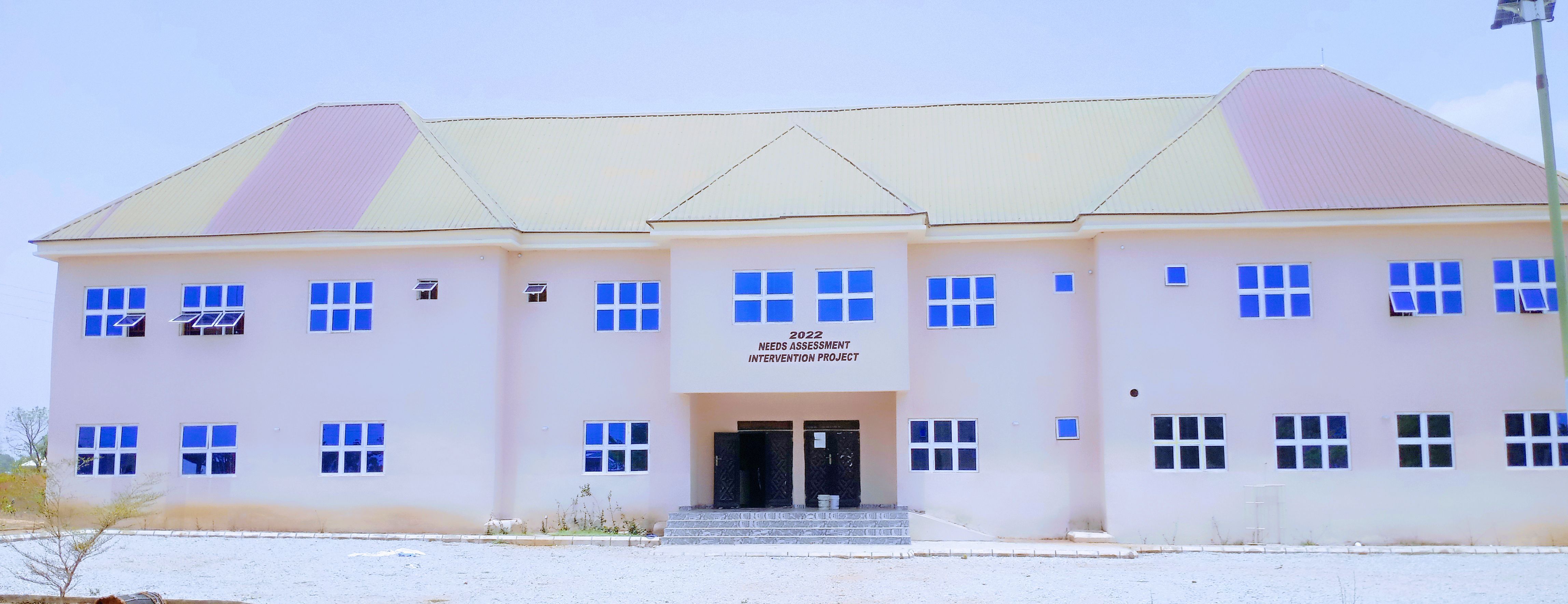
Department of Biochemistry and Chemistry

SCHOOL OF SCIENCE AND TECHNOLOGY
Department of Biochemistry and Chemistry
The Department of Biochemistry and Chemistry was established in 2019. Following the NBTE resource inspection visit, the Higher National Diploma (HND) Biochemistry and Chemistry programmes were granted approval and commenced in the 2019/2020 academic session with 20 pioneer students.
Federal Polytechnic Bali currently runs full-time HND programmes of two (2) years duration leading to the award of HND SLT Biochemistry and Chemistry after re-accreditation by the NBTE in November 2023. The department presently has 22 staff and 55 students and has graduated 28 students, many of whom have been mobilized for the NYSC programme.
The Department also provides service courses for ND SLT, Animal Health Technology and Crop Production departments.
GOAL AND OBJECTIVE OF THE PROGRAMME
This programme is designed to produce biochemical technologists capable of applying laboratory techniques to complement the work of scientists in industrial and laboratory biochemical analysis and production processes.
OBJECTIVES
On completion of the programme the graduate of HND in Biochemistry and Chemistry should be able to carry out biochemical analysis in laboratories across education, food and chemical industries and in research institutes.
ENTRY REQUIREMENTS
Applicants with any of the following may be considered for admission into the HND SLT Biochemistry and Chemistry programmes:
- Five credit level passes in GCE “O” Level or SSCE, NECO and NABTEB in not more than two sittings. Required subjects include English Language, Mathematics, Biology/Agricultural Science, Chemistry and Physics.
- A minimum of lower credit in National Diploma Science Laboratory Technology (ND SLT) obtained from an NBTE-accredited programme in a reputable institution, with one year supervised Industrial Experience. In exceptional cases, applicants with a Pass grade may be considered if they can demonstrate at least two years Industrial Experience or an equivalent certificate.
STRUCTURE OF PROGRAMME
The HND Biochemistry/Chemistry programme is terminal and is structured to last for two years (four semesters). The training incorporates a supervised industrial attachment of between four to six months.
CONDITION OF AWARD
Institutions offering accredited programmes will award the Diploma to candidates who successfully complete the programme after passing prescribed coursework, examinations, a diploma project and the supervised industrial work experience. Candidates should complete a minimum of between 72 and 80 semester credit units depending on the programme.
Diplomas shall be classified as follows:
- Distinction - GPA of 3.50 and above
- Upper Credit - GPA of 3.00 - 3.49
- Lower Credit - GPA of 2.50 - 2.99
- Pass - GPA of 2.00 - 2.49
- Fail - GPA below 2.00
CURRICULUM
The curriculum consists of four main components: General Studies/Education, Foundation Courses, Professional Courses, and the Student Industrial Work Experience Scheme (SIWES).
The General Education component includes courses in Arts and Humanities (English Language, Communication, History) as well as Mathematics and social studies. Foundation courses cover topics such as Economics, Mathematics, Pure Sciences, Technical Drawing, descriptive geometry and Statistics. Professional courses deliver the core theoretical and practical skills required at the technician/technologist level and typically account for 60–70% of contact hours.
Preview More on PDFACCREDITATION
All programmes at ND or HND levels must be accredited by the NBTE before diplomas are awarded. Details about accreditation are available from the Executive Secretary, Programmes Division, National Board for Technical Education, Plot B, Bida Road, P.M.B. 2239, Kaduna, Nigeria.
GUIDANCE NOTE FOR TEACHERS
The curriculum is drawn in unit courses to align with the National Policy on Education and the semester credit system, enabling transfer of completed units between institutions of comparable standards.
In designing the units, the modular principle has been adopted so that completion of each professional module confers practical technician skills useful for employment. The curriculum content is presented in behavioral objectives to clarify expected student performance. Departments are encouraged to tailor final curricula to local conditions; submissions may be vetted by the institution's Academic Board.
Practical and theoretical work should be integrated where possible. Practical exercises—particularly in professional courses and laboratory work—should not be taught in isolation; aim for a balance of theory and practice 50:50 or 60:40.
Explore the Department